
Comfortable Is Not the Same as Safe
What your money is actually doing while you are not watching it
Movement one
The response to the letter
The letter went out on 10 April. I did not know what to expect.
What came back was not what I anticipated. Not debate. Not pushback. Recognition. People said yes, that is exactly how it feels. Some forwarded it to their partners. One reader sent it to her adult children with a single line: read this. Several people replied saying they had been trying to articulate that feeling for years and had concluded the problem was them: their choices, their discipline, their failure to understand something everyone else seemed to have figured out.
That response told me something. The feeling is not niche. It is not the province of people who read macro finance newsletters or track monetary policy. It is sitting quietly inside people who have done everything right: the KiwiSaver contributions, the managed fund, the term deposit, the occasional Sharesies purchase. And still, at the end of each year, the number is not moving the way it should.
Two readers crystallised the response into a question.
Simon put it plainly: I see it, now what? What do I actually own, and why? What helps me understand the different categories of assets and their possible futures before I make decisions I cannot easily undo?
Pierre asked the same thing differently, but arrived at the same place.
Both of them already had the feeling. Both had arrived at conviction. Neither had a framework to act on it. That gap, between understanding something and knowing what to do about it, is where most people get stuck. And getting stuck there is not comfortable. It is just a more informed version of paralysis.
But before this piece answers Simon’s question, it has to ask a harder one. Because Simon already knew something was wrong. He had read enough, felt enough, and been honest enough with himself to name it.
Most people have not done that. Most people are David. And David is the reason this piece exists.
Movement two
David’s statement
David is 58. He lives in Christchurch. Two properties worth a combined $1.8 million. $380,000 in KiwiSaver. $420,000 in a Milford Active Growth Fund.
His most recent annual statement shows a 5.30% return, after fees and taxes. He is ahead of the average growth fund, which returned 3.44% for the same period. He feels good about this. His fund beat the average.
Here is what the statement does not show.
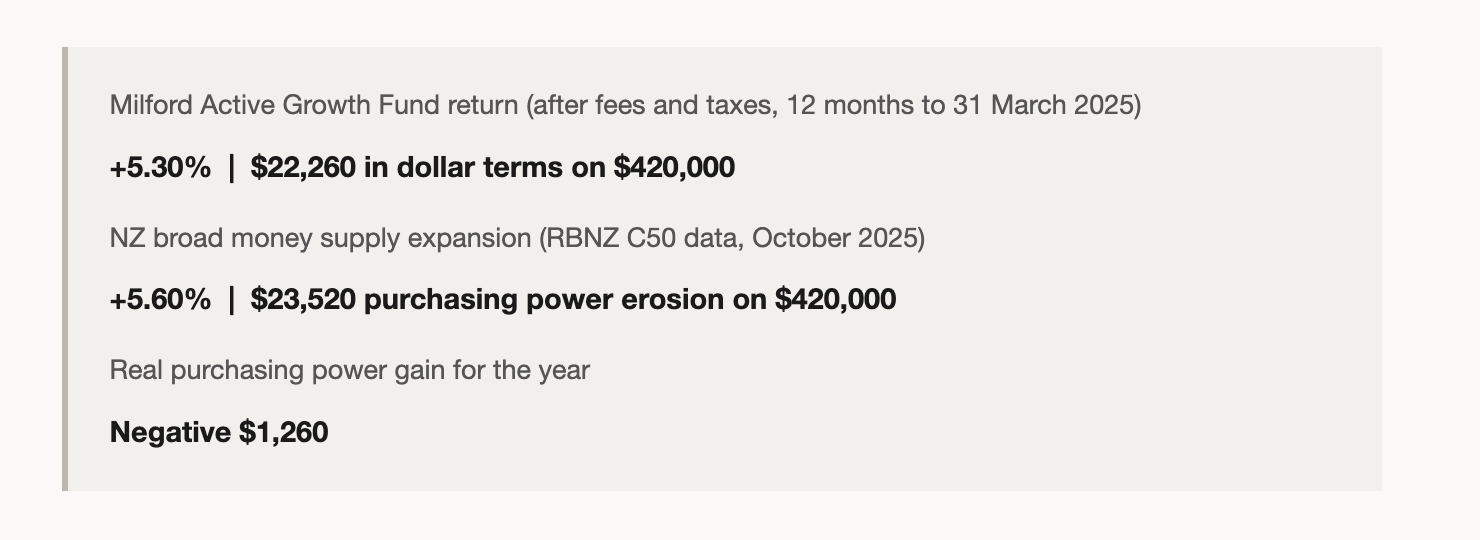
Negative $1,260
David’s fund beat the average. It did not beat the expansion of the currency it is denominated in. His statement showed a positive number. His purchasing power went backwards. Both things are true simultaneously. Nobody sent him that paragraph.
This is not an argument against Milford. They delivered above-average returns. This is an argument about the architecture. The architecture measures returns in a currency that expands at 5 to 6 percent per year. A fund can beat its peers, beat its benchmark, and still leave you poorer in real terms. The statement will never show you this. It is not designed to.
The statement showed a positive number. The purchasing power went backwards. Both things are true simultaneously.
Movement three
The products we were sold
Walk through the standard retail financial product suite. Not to attack it. To show what each product actually does when measured against purchasing power rather than nominal returns.
Term deposits. Five percent in a seven percent monetary expansion environment is not a return. It is a managed loss with a positive number on the statement. The bank is paying you less than the rate at which it is expanding the currency you are being paid in. This is not a secret. It is in the math.
KiwiSaver. The government forces savings. Savings are allocated across managed funds. Managed funds buy government bonds, Australian bank shares, US tech stocks, NZ property REITs. The government spends borrowed money, creates inflation, and devalues the savings. The balance goes up. The statement looks good. The purchasing power goes quietly sideways. This is the circular architecture of compulsory savings in a debasement environment. The machine feeds itself.
Managed funds. The risk profile conversation is not designed around your purchasing power. It is designed around benchmark risk. A growth profile means your money is positioned aggressively relative to a benchmark, not aggressively relative to the debasement rate. These are different things. One protects your statement. The other protects your wealth.
Investment apps. Sharesies, Hatch, and their equivalents are the most honest products on this list. They give you access. They do not give you intelligence. You can own a piece of Amazon in thirty seconds. You cannot see what institutional players are doing in that position. You cannot see the dark pool flows, the whale activity, the macro signals that move the price before retail investors see the news. Access without intelligence is participation without understanding. It is better than not participating. It is not the same as being equipped.
The S&P 500 index. The Reddit consensus. Just buy the index. Simple, diversified, low cost. True as far as it goes. But as of April 2026, the index is approximately 33.7 percent concentrated in seven companies, up from 12.5 percent in 2016. The diversification you are buying is partly an illusion. And like all the products above, its returns are measured in a currency whose supply expands at five to seven percent per year in most developed economies. The index can go up while your purchasing power goes sideways. Both things can be true simultaneously.
None of these products are fraudulent. None of the people selling them are villains. The architecture is the problem. And the architecture is invisible unless you know what to look for.
Movement four
The intelligence gap
In late February 2026, three economists from the same bank published three separate pieces in the same week.
Satish Ranchhod, Senior Economist at Westpac New Zealand, posted a chart tracking consumer prices since 2002. The headline: CPI up 83 percent over 23 years. Roughly 2.5 percent a year. Manageable. Contained. Exactly what the inflation-targeting framework was designed to deliver.
But the chart did not stop at the headline. Underneath it, the lines fanned out like cracks in a windscreen. Council rates up 300 percent. Building costs up 224 percent. Household energy up 173 percent. Insurance up 150 percent. Rent up 88 percent. Food up 85 percent. And at the very bottom of the chart, communications at negative 31 percent. Your phone plan got cheaper. Your ability to keep the lights on did not.
Kelly Eckhold, Westpac’s Chief Economist, responded with a single line. Wages up 137 percent over the same period. CPI up 83 percent. Workers are ahead. Case closed.
Except they are not. And his own colleague’s chart is the proof. When I pointed out that 137 percent wage growth does not touch council rates at 300 percent, building costs at 224 percent, or energy at 173 percent, the response was that wage demands adjust to reflect inflation over time. An equilibrium that insulates households over the medium run.
The medium run. That is the tell. Because in the medium run, a generation of young New Zealanders has watched housing become a seven-times-income proposition. The equilibrium requires a labour market with bargaining power. With unemployment at 5.4 percent and youth unemployment at 13 to 15 percent, that labour market does not exist.
Michael Gordon, another Westpac Senior Economist, published a piece titled “The Houseless Recovery,” exploring whether New Zealand’s economy can recover without rising house prices. It is a reasonable institutional question. But it reveals the frame. The concern is not that a generation cannot afford to live in a house. The concern is that the economy might not grow if house prices do not.
Three economists. Same bank. Same week. One publishes a chart showing essentials have outpaced headline inflation by two to four times. Another argues wages beat CPI so households are fine. A third asks if the economy can function without further house price growth, without asking whether it can function when the entry price is already seven times income.
None of them connected the dots. Because connecting the dots leads somewhere that institutional economics cannot go. It leads to the architecture itself.
This is the intelligence gap. It is not just about data. It is about the framework for interpreting data. Institutions have it. They pay for it. Retail investors do not have access to it by default.
Here is what that gap looks like in practice.
From 6 March through 12 March 2026, StackMotive fired ten consecutive bearish CONVERGENCE alerts on Northern Star Resources, a major ASX gold miner. Seven consecutive days. Each alert flagged the same signal: high severity, bearish convergence across multiple indicators. The alerts preceded the move. On 13 March, Northern Star crashed 18 percent following an operational update released at 10:22am AEDT. The final CONVERGENCE alert had fired at 20:05 UTC the previous evening, three hours and seventeen minutes before the announcement.
A retail investor with access to that signal had the same read as an institutional desk. Not because they were smarter. Because they had the same information architecture.
That is what access to institutional intelligence actually means. Not tips. Not predictions. A framework for seeing what the system is doing before the news reports it.
Movement five
The new wrapper on the old product
On 17 April 2026, two days after StackMotive launched commercially, Sharesies released Advised Portfolios. It was the most anticipated ANZ financial product of the year. Eight thousand people joined the waitlist on day one.
I want to be fair about what it is, because the language around it matters.
Advised Portfolios is genuinely well-engineered for what it does. It asks about your investment timeframe, your comfort with risk, your financial security, and your investing preferences. It returns a diversified portfolio recommendation ranging from conservative to high-growth. It auto-rebalances quarterly, reinvests dividends, uses PIE tax-efficient investments to protect your returns, and includes hedged ETFs to manage currency exposure. The fees are transparent and disclosed upfront. For someone who has never invested before and wants a sensible starting point, this is a reasonable product.
But here is what it does not ask.
It does not ask what you believe about money. It does not ask whether you think currency debasement is the variable most investors ignore. It does not ask whether you are trying to preserve what you have built or grow it aggressively before the system extracts more of it. It does not ask whether your edge is patience, or process, or macro awareness, or concentrated conviction in a thesis you have spent years building.
And I looked at more than one hundred investor platforms across seven geographies over the past month. Not one of them asks those questions. Every single one, from the largest institutional platforms to the newest fintech entrants, does a version of the same thing. They measure your risk tolerance. They route you to a product. They call it personalisation.
Sharesies built the best possible version of that model. The problem is not Sharesies. The problem is the model itself.
Because risk tolerance tells a platform what box to put you in. Investment philosophy tells a platform how to think alongside you.
Those are not the same thing. And the distinction is the entire gap between what exists today and what should exist.
Risk tolerance tells a platform what box to put you in. Investment philosophy tells a platform how to think alongside you. Those are not the same thing.
Movement six
What conviction without infrastructure actually is
Simon asked: okay, I see it. Now what?
Here is the honest answer.
Seeing it is not enough. Conviction without a framework to act on it is just anxiety with better vocabulary. You can understand the debasement thesis completely and still make emotional decisions with your portfolio. You can know that the monetary architecture is extracting from you and still leave your money in the products designed to route you through it.
What sits between conviction and action is infrastructure.
The investors who navigate this environment well are not smarter than David. They have a system that operates above the extraction layer. It starts with a framework for understanding what is happening: a worldview built on data, not on the consensus that got everyone to the same place at the same time. It continues with an orientation layer that connects that worldview to your actual situation: your capital position, your life stage, your risk capacity, your existing exposure. Then it adds an intelligence layer that surfaces what institutions see: the flows, the signals, the macro context that moves markets before retail investors hear about it. And it ends with an execution layer that removes the emotional decisions that keep most retail investors trapped inside the system they are trying to understand.
That architecture does not need to cost US$24,000 per year. It does not need a Bloomberg Terminal. It needs to be built deliberately, layered correctly, and accessible to anyone who is willing to engage with their financial reality honestly.
Movement seven
The decision that precedes every other decision
This is where most pieces like this lose people. They build the argument, show the problem, name the alternative, and then implicitly require the reader to become someone they are not.
This piece will not do that.
The spectrum runs from David on one end to the active thesis investor on the other. David is fully delegated, comfortable, and extracting slowly without knowing it. The active thesis investor has a written investment constitution, automated execution rules, and a macro framework built from first principles. Most people are not going to the active thesis end. They should not feel they need to.
But they do need to move off David’s position. Because David’s position is not safe. It just feels safe.
Taking control does not mean trading actively. It does not mean developing a macro thesis. It means making deliberate decisions about what you own and why, even if those decisions are simple. It starts with one question that every other question depends on.
Not: how much risk can I handle?
But: what do I actually believe about money?
That is the question Sharesies does not ask. That is the question no platform I have found in seven geographies asks. Because asking it changes everything downstream. It means your intelligence has to be filtered through your conviction. It means your signals have to speak your language. It means your portfolio can be held up against what you said you believed and the gap, if there is one, becomes visible.
Even if your answer to that question is just this:
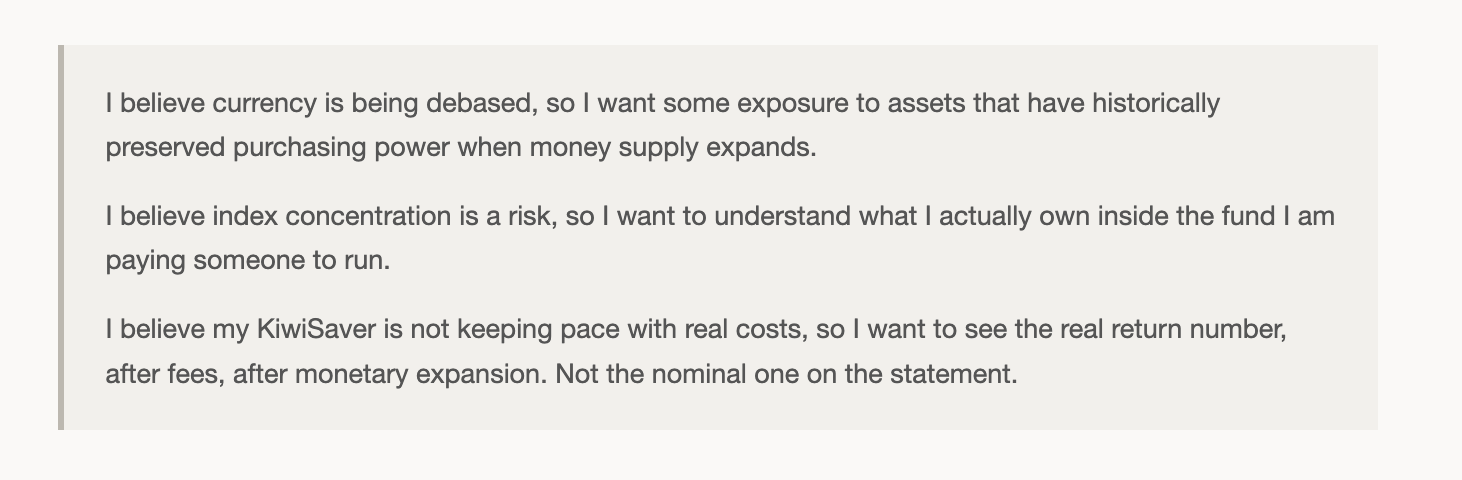
That is conviction. Not sophisticated conviction. Just honest engagement with your own financial reality instead of delegating the question to someone whose interests are not the same as yours.
Movement eight
Conviction to clarity: and what comes next
That question, what do I actually believe about money, is the foundation of everything The Sovereign Signal has been building toward.
On Monday 11 May, Vector launches.
Vector is not a risk quiz. It is not a product recommender. It is not Sharesies with different language. It is thirteen questions that identify what you believe, not just what you can afford to lose. Five minutes. No sign-up. No ETF bundle waiting at the end.
What it returns is an investor profile: your philosophy, your capital position, your life stage, where you actually sit on the spectrum between David and the active thesis investor. Not a box. A mirror.
And that profile does not sit in isolation. It travels directly into StackMotive, the intelligence platform that sits behind it. So when you open StackMotive for the first time, it already knows what you believe. A Capital Preservation investor and a Disruptive Growth investor looking at the same market event will see a different read, because the same signal means something different depending on what you are trying to protect or build. The intelligence is filtered through your declared conviction, not through a generic risk score.
No platform anywhere does this. I know, because I looked at more than one hundred of them before I built it.
The entry point is understanding what you believe. Not what product to buy. Not what risk profile you fall into. What you actually think is happening in the monetary system, and whether your portfolio reflects that or not.

Movement nine
The questions
This piece ends differently to the letter.
The letter ended with an invitation to look. This piece ends with questions. Not rhetorical ones. Real ones, the kind I genuinely want you to answer. Hit reply, comment or DM me. Tell me where you sit. Tell me I have got it wrong. Tell me what you are actually doing with your money and whether it reflects what you believe. I read every response. The ones that arrived after the letter shaped this piece. The ones that arrive after this one will shape what comes next.
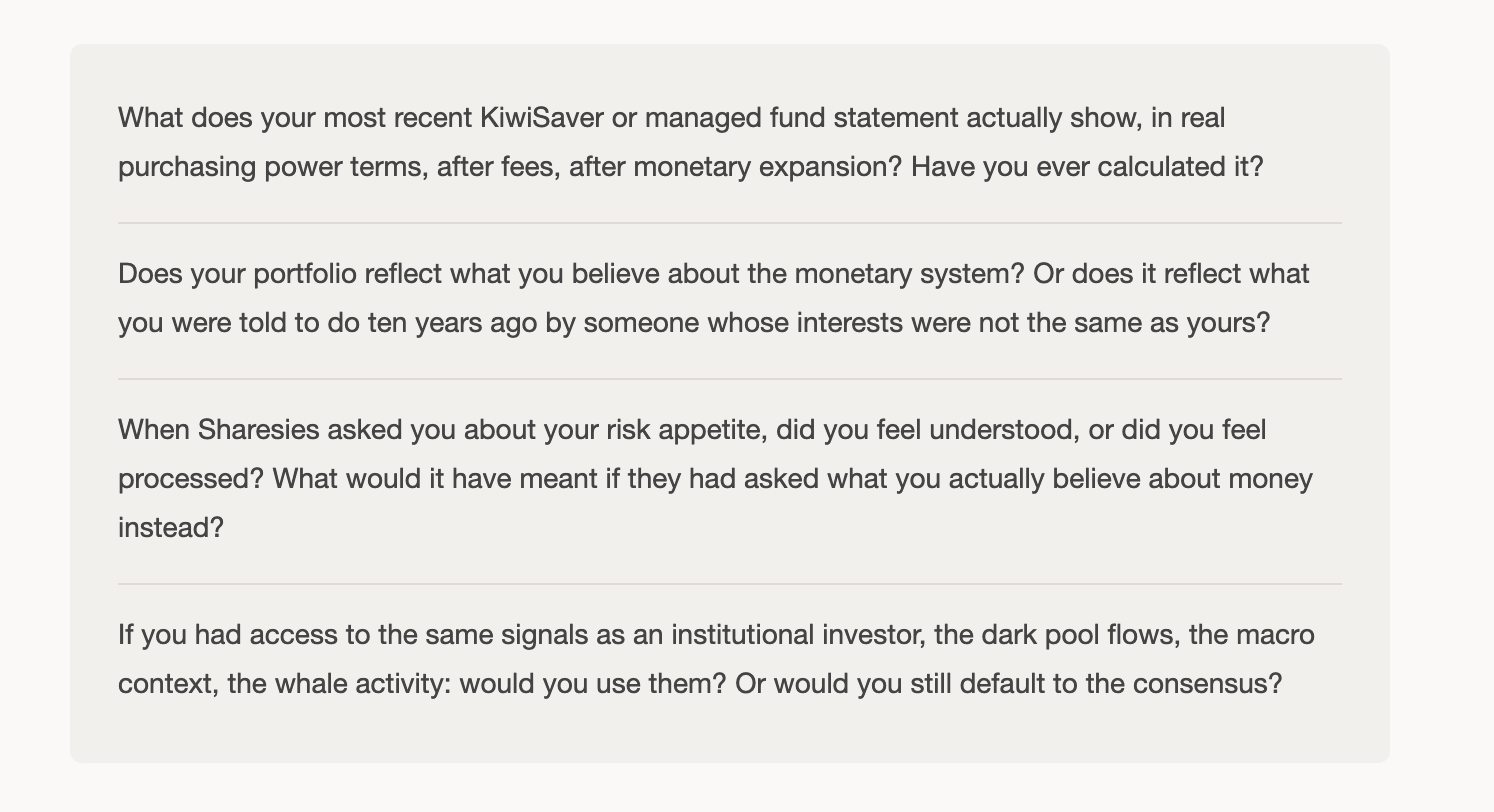
These are not trick questions. They are the questions that determine whether this article changed anything for you beyond the feeling.
Reply with your answer. I mean that literally. The responses will shape what comes next.